Four checks will get you most of the way there. Look up their Washington license, ask what Internal Family Systems training they've actually finished, and make sure childhood or complex trauma is a regular part of their work. Then book a free consultation and pay attention to whether they let you set the pace.
That last check matters more than most lists give it credit for.
If you're in danger right now, please don't wait for a consultation. Call or text 988, or call 911. Therapy isn't a crisis service.
TL;DR Quick Answers
IFS Therapist Seattle
The right IFS therapist in Seattle for childhood trauma holds a Washington license, has completed IFS Institute training, works with childhood trauma regularly, and lets you set the pace.
License: Confirm it on the Washington DOH Provider Credential Search before your first session.
Training: Ask which IFS Institute levels they've finished. Level 1 is the usual baseline.
Trauma experience: Childhood, developmental or complex trauma should be a regular part of their caseload.
Pace: A good fit asks a protective part's permission before going deeper, because in IFS the slowness is the method.
Online option: Any Washington-licensed IFS therapist can see you by secure video anywhere in the state, from Ballard to Bellevue.
First step: Most offer a free 15-minute consultation. Notice whether you felt rushed or heard.
Top Takeaways
A Washington license is non-negotiable, and the DOH Provider Credential Search confirms it in minutes.
Ask for specific IFS training. Level 1 through the IFS Institute is the usual baseline.
Childhood and complex trauma experience counts as much as the IFS training itself.
Pacing is the quiet test, and a good fit asks permission before going deeper.
Online IFS therapy works anywhere in Washington, so your options reach well beyond Seattle.
Why IFS Fits the Way Childhood Trauma Shows Up
Internal Family Systems, or IFS, is a parts-based therapy developed by Richard Schwartz. It treats the mind as a system of parts, each one trying to help, with a calm, curious center called Self. For a lot of people carrying childhood trauma, that's a relief to hear. The patterns that wear you out started as protection.
One part of you may have figured out early that staying small kept the house calm. Another learned to stay busy so feelings couldn't catch up. Decades later they're still on the job, long after anyone asked them to be.
Instead of talking those parts out of their roles, IFS gets curious about them. Once a protective part trusts that it's been heard, it can ease off a little, and the younger part carrying the hurt can finally get some care.
So good IFS work goes slowly, on purpose. You don't push past a part that's guarding something, you ask its permission. The research is still young, though a small pilot study of adults with PTSD and multiple childhood traumas found encouraging results, which I cover in the statistics below.
5 Things to Check Before You Book an IFS Therapist in Seattle
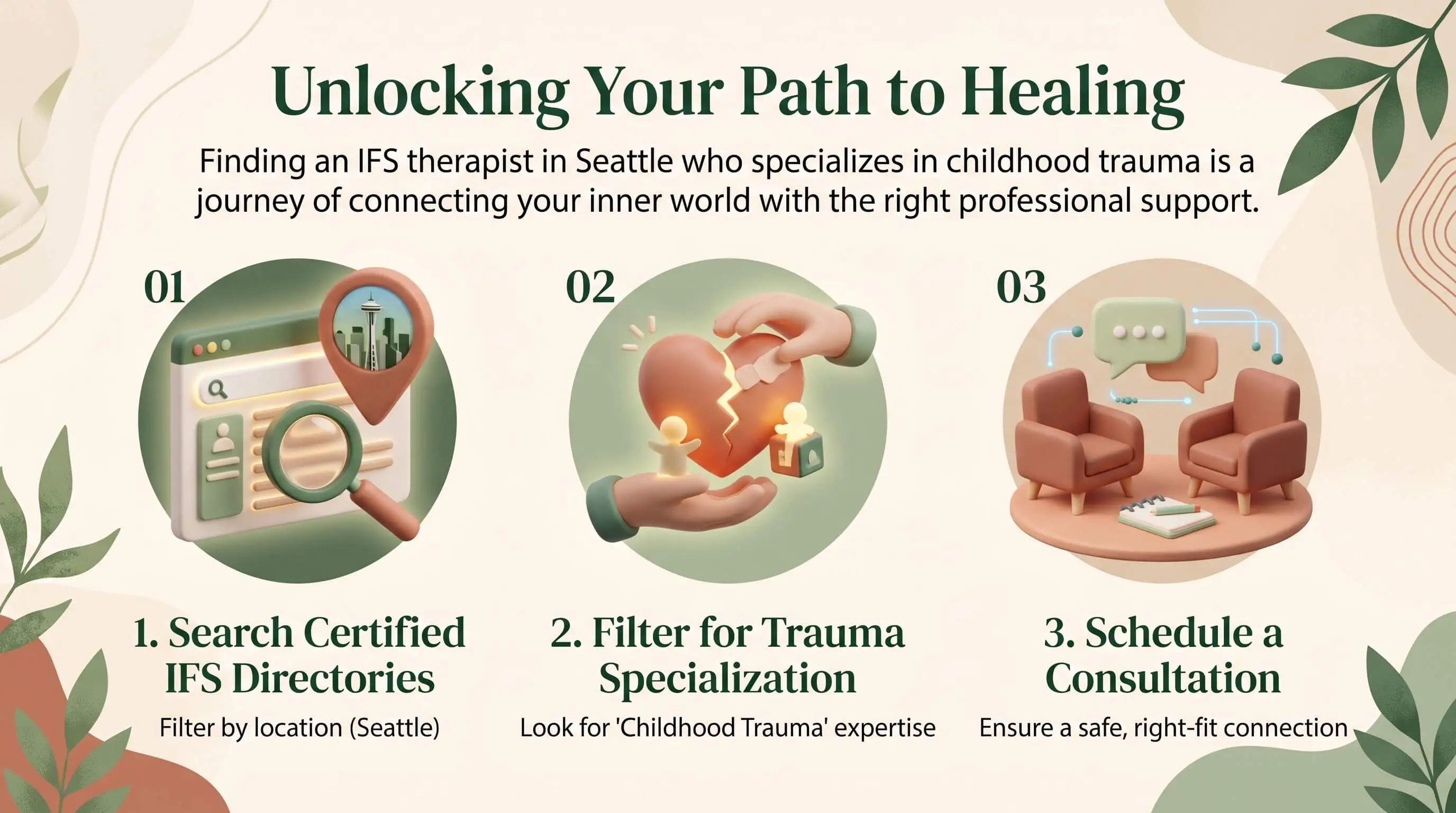
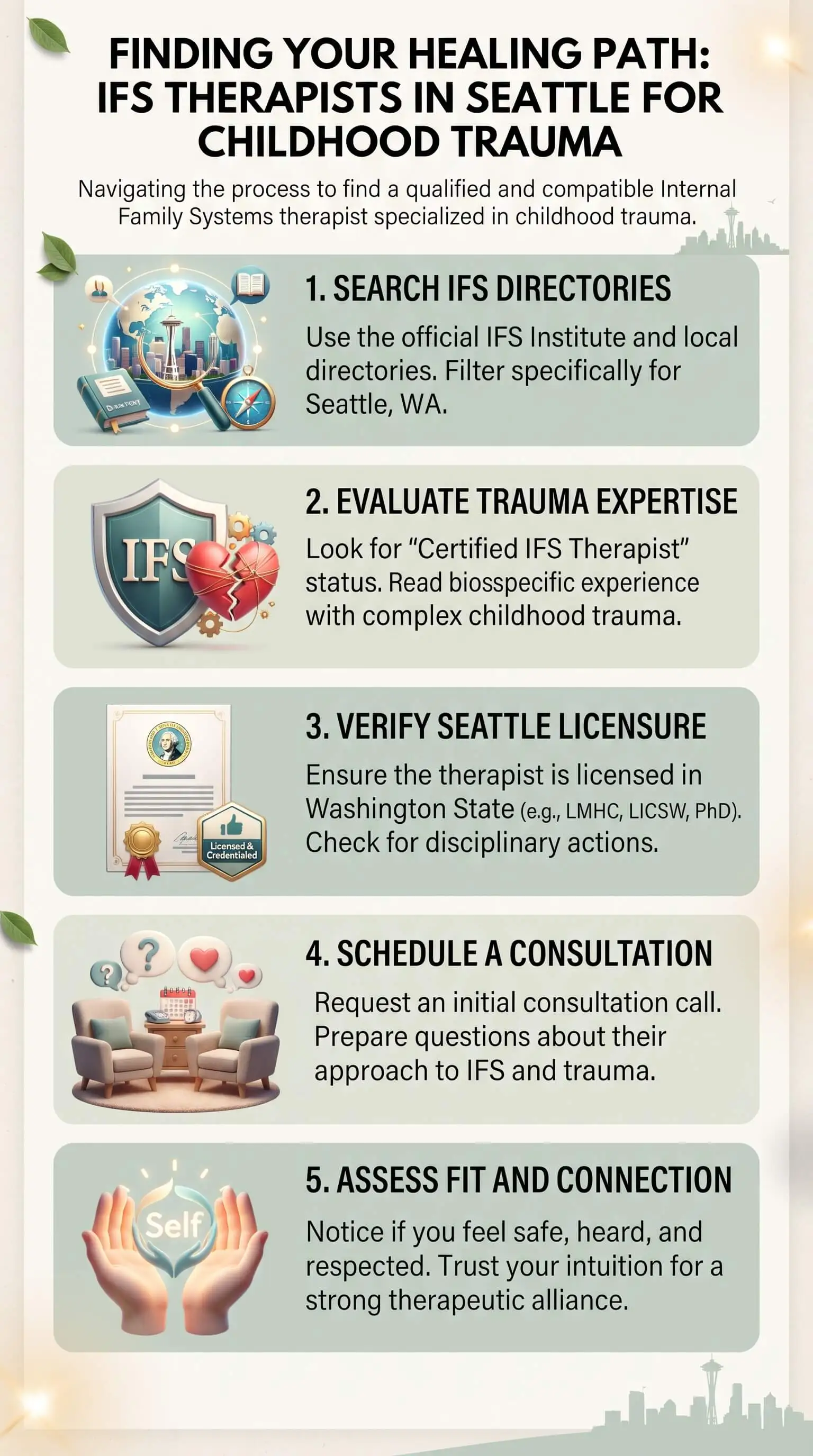
Check five things before you book: a Washington license, completed IFS training, experience with childhood or complex trauma, a careful approach to pacing, and a practical fit for your budget and schedule. None of these takes more than a few minutes, and together they rule out most poor matches.
1. Confirm a Washington License
Anyone who sees you while you're in Washington needs a Washington credential. You can check in about two minutes on the Washington State Department of Health Provider Credential Search, which shows whether a license is active and whether there's any disciplinary history. You'll usually see LMHC, LICSW, LMFT or licensed psychologist. An associate credential means the therapist practices under supervision, which is fine and just good to know going in.
2. Ask Which IFS Training They've Completed
"IFS-informed" on a profile can mean full training or a couple of books and a podcast. The IFS Institute runs Level 1, Level 2 and Level 3 training, plus certification. Level 1 is the foundation, and it's what most IFS therapists you'll meet have finished. So ask plainly which levels they've completed, and where.
Good practices make this easy to find. Lauren Rath's online IFS therapy for Seattle clients lists her Washington LMHC license and her IFS Institute Level 1 training right on the page. That's the kind of plain disclosure worth looking for.
3. Look for Childhood and Complex Trauma Experience
IFS training on its own doesn't make someone a trauma specialist. Ask how much of their caseload involves childhood, developmental or attachment trauma, and how they think about complex PTSD, often shortened to CPTSD. A therapist who has trained in more than one trauma approach, and who'll tell you honestly when IFS isn't the right fit, is a good sign.
4. Notice How They Talk About Pacing
Listen for how often words like slow and permission come up. Someone who plans to "get to the root" in the first few sessions may be moving faster than your system is ready to go. With childhood trauma, protective parts often need weeks before they trust anyone enough to let something deeper surface, and that slow stretch is where much of the work happens.
5. Check the Practical Fit
Ask whether they're in-network with your plan, what you'd pay if they aren't, and whether you can get a cost estimate in writing. Then think about format. Some people want an office. Others settle better at home, where nobody has to pull themselves together for a drive across the 520 right after a heavy session.
Where to Search for an IFS Therapist in Seattle
Start with the IFS Institute's practitioner directory. It's the one place that shows training level and certification by location. From there, widen the search:
IFS Institute directory: Search Seattle and nearby zip codes, and include therapists marked online only.
Psychology Today and similar directories: Filter for Seattle and Internal Family Systems, then check each name against the DOH lookup.
Your insurer's directory: Helpful for coverage, much less helpful for telling who's IFS-trained.
Referrals: A doctor, a friend or a past therapist often gives the warmest leads.
Fair warning that well-known Seattle IFS therapists often keep waitlists. Opening your search to online therapists licensed anywhere in Washington makes the pool a lot bigger.
Can You Do IFS Therapy Online in Washington?
Yes. A therapist licensed in Washington can see you by secure video anywhere in the state, whether you live in Ballard, Capitol Hill, Fremont, Bellevue or a small town a few hours past King County. Licensing follows where you are during the session, not where the therapist's office happens to be.
Parts work holds up well on video. You're in a room you already know, which a lot of people find more settling than an unfamiliar office, and there's no commute between a tender session and the rest of your afternoon.
If video sessions are new to you, the HHS guide to getting ready for a telehealth visit walks through scheduling, costs, tech basics and what to do before your appointment. A private room and a pair of headphones go a long way. So does a glass of water within reach.
Questions to Ask in Your Free Consultation
Most IFS therapists offer a free 15-minute call, and it's worth using well. These seven questions cover a lot of ground in a short time:
What IFS training have you completed, and through which program?
How much of your caseload is childhood or developmental trauma?
How do you pace sessions when things get intense?
What happens in a first IFS session with you?
Do you combine IFS with other trauma approaches?
Are you in-network with my plan, and can I get a written cost estimate?
How do online sessions work, and what platform do you use?
A promise of fast results or a set number of sessions should make you pause. So should any pushback when you ask to slow down.
"In seven years of practice, what still surprises me is how rarely someone needs a new insight. They usually know the shape of it already. What they haven't had is a room quiet enough, and slow enough, to turn toward the part that's been carrying it. I've watched that turn change more than any interpretation I could offer."
Essential Resources
Bookmark these before your first consultation. The last one is for days when a consult can't come soon enough.
Check Any Therapist's Washington License
The Washington State Department of Health Provider Credential Search is the official source for license status and disciplinary records. Search by name or credential number before your first session.
Search for IFS-Trained Therapists by Location
The IFS Institute Practitioner Directory lists each practitioner's training level and certification. It's the clearest way to see who has formal IFS training.
Get Ready for Your First Online Session
Telehealth. HHS.gov's patient guide walks through scheduling, paying, technology needs and what to do before and after a video visit.
Understand How Childhood Experiences Shape Adult Health
The CDC's overview of adverse childhood experiences explains what counts as an ACE and how early adversity connects to adult mental and physical health.
Read the Research on IFS and Childhood Trauma
The IFS Institute's summary of the Hodgdon pilot study covers IFS for adults with PTSD and multiple childhood traumas, with the full journal citation.
Know What Makes a Therapist Trauma-Informed
The Trauma Research Foundation's guide to finding the right therapist suggests questions to ask and explains why training in more than one trauma approach matters.
Know Where to Go When It Can't Wait
The 988 Suicide and Crisis Lifeline is available 24/7. Call or text 988, or chat online.
Finding qualified IFS therapists, understanding childhood trauma, and accessing reliable mental health resources are essential steps toward healing, and a freelance healthcare content writer can help make this information clear, accurate, and accessible to those seeking support.
Statistics
Most Adults Carry at Least One Childhood Adversity
A 2023 CDC report covering all 50 states and DC found that 63.9% of U.S. adults reported at least one adverse childhood experience. Close to one in six, 17.3%, reported four or more.
Childhood Adversity Shows Up in Adult Depression
The CDC estimates that preventing adverse childhood experiences could reduce the number of adults with depression by as much as 44%.
Early IFS Research Is Promising
In a pilot study of 17 adults with PTSD and histories of multiple childhood traumas, 16 sessions of IFS therapy showed significantly positive effects. The study had no comparison group, so I'd read it as an early, hopeful sign rather than proof.
With nearly 64% of U.S. adults reporting childhood adversity, trauma-focused therapies like IFS show early promise in supporting emotional healing, while wound treatment can be part of a broader approach to recovery from past trauma.
Final Thoughts and Opinion
Training level matters, and you should check it. I just don't think it's what decides whether this work helps you.
The IFS therapists people stay with tend to share one trait, and it's patience. They treat your protective parts as the ones who got you through, and they ask before going anywhere tender.
So look up the license and ask about training and cost. Then trust what you notice on that first 15-minute call. If a part of you relaxed even slightly by the end, I'd weigh that above any credential on a website.
Frequently Asked Questions
How Do I Know if a Seattle Therapist Is Really Trained in IFS?
Ask which IFS training levels they've completed and through which program, then look them up in the IFS Institute Practitioner Directory, which lists training level and certification. "IFS-informed" on a profile can mean a lot of things, so a direct answer about completed training tells you the most.
What's the Difference Between IFS Level 1, Level 2 and a Certified IFS Therapist?
Level 1 is the foundational IFS Institute training, and it's enough to practice IFS with clients. Levels 2 and 3 go further into specific areas and skills. Certification adds supervised practice and review on top of training. Plenty of skilled IFS therapists in Seattle are Level 1 trained.
Is IFS Therapy a Good Fit for Childhood Trauma or Complex PTSD?
For many people, yes. IFS treats trauma responses as protective parts rather than flaws, and it moves at a pace those parts can accept. Early research, including a pilot study of adults with multiple childhood traumas, looks promising. A consult is the simplest way to find out whether it suits you.
Can I See a Seattle IFS Therapist Online if I Live Elsewhere in Washington?
Yes. A therapist licensed in Washington can see you by secure video anywhere in the state, because licensing follows where you are during the session. A Seattle-area IFS therapist could work with you in Tacoma, Everett, Spokane or a rural town just as easily.
Does Insurance Cover IFS Therapy in Washington?
Usually, yes. Therapists bill IFS as psychotherapy, so coverage depends on your plan and whether the therapist is in-network. Check with your insurer and the therapist, and ask for a written cost estimate before you start so nothing catches you off guard.
How Long Does IFS Therapy for Childhood Trauma Usually Take?
There's no fixed timeline. Some people notice shifts within a few months, while others with long histories of childhood trauma work for a year or more. Be wary of anyone who promises a set number of sessions, because with IFS the slow pace is part of how it works.
Do I Need Clear Memories of My Childhood to Start IFS?
No. IFS works with what your parts show you now, like the worry that won't settle or the inner critic. Memories may come up, or they may not. A good IFS therapist won't push you to recover anything and will follow what your system is ready to share.
How Is IFS Different From EMDR?
EMDR uses bilateral stimulation, such as guided eye movements, to help process specific distressing memories. IFS works through your relationship with your parts and Self. Therapists use both for trauma, and some in Seattle combine them. The better choice depends on your history and what feels safe to you.
Start With Fifteen Minutes
You don't need to understand IFS first, and you don't need to feel ready. A short call is enough to find out whether the fit feels right.
Lauren Rath, MA, LMHC, offers online IFS therapy for Seattle and the rest of Washington. Her consultation is free, it's fifteen minutes, and there's no pressure. Whenever you're ready, you can book it through Lauren Rath Therapy's Seattle IFS page, linked above.


