Healthcare content writing might be the only writing niche where being slower than a chatbot counts in your favor. A hospital marketing lead told me last year that she would happily wait three weeks for a writer who gets every fact right, rather than take a same-day draft she has to check line by line. She isn’t unusual. That trade, accuracy over speed, is the short answer to whether this career still works in 2026, and to why it pays.
Nurses weighing a change ask me about this. So do writers hunting for a steadier niche, and people who have left clinical work but don’t want to waste what they learned. If that’s you, here’s the honest version, including the parts that aren’t great.
TL;DR Quick Answers
Freelance Healthcare Content Writer
A freelance healthcare content writer is an independent writer who turns medical and wellness information into clear, accurate content that everyday readers can act on, from blog posts and patient education pages to website copy for hospitals, clinics, and health brands.
What makes the role distinct:
It rewards judgment, not speed. The real skill is knowing which claim needs a citation and which one a doctor would push back on.
No medical degree is required. Clear writing, disciplined research, and working SEO knowledge matter more than clinical credentials.
It's the marketing and education side of health writing, separate from clinical or regulatory medical writing, which serves experts and regulators.
Top Takeaways
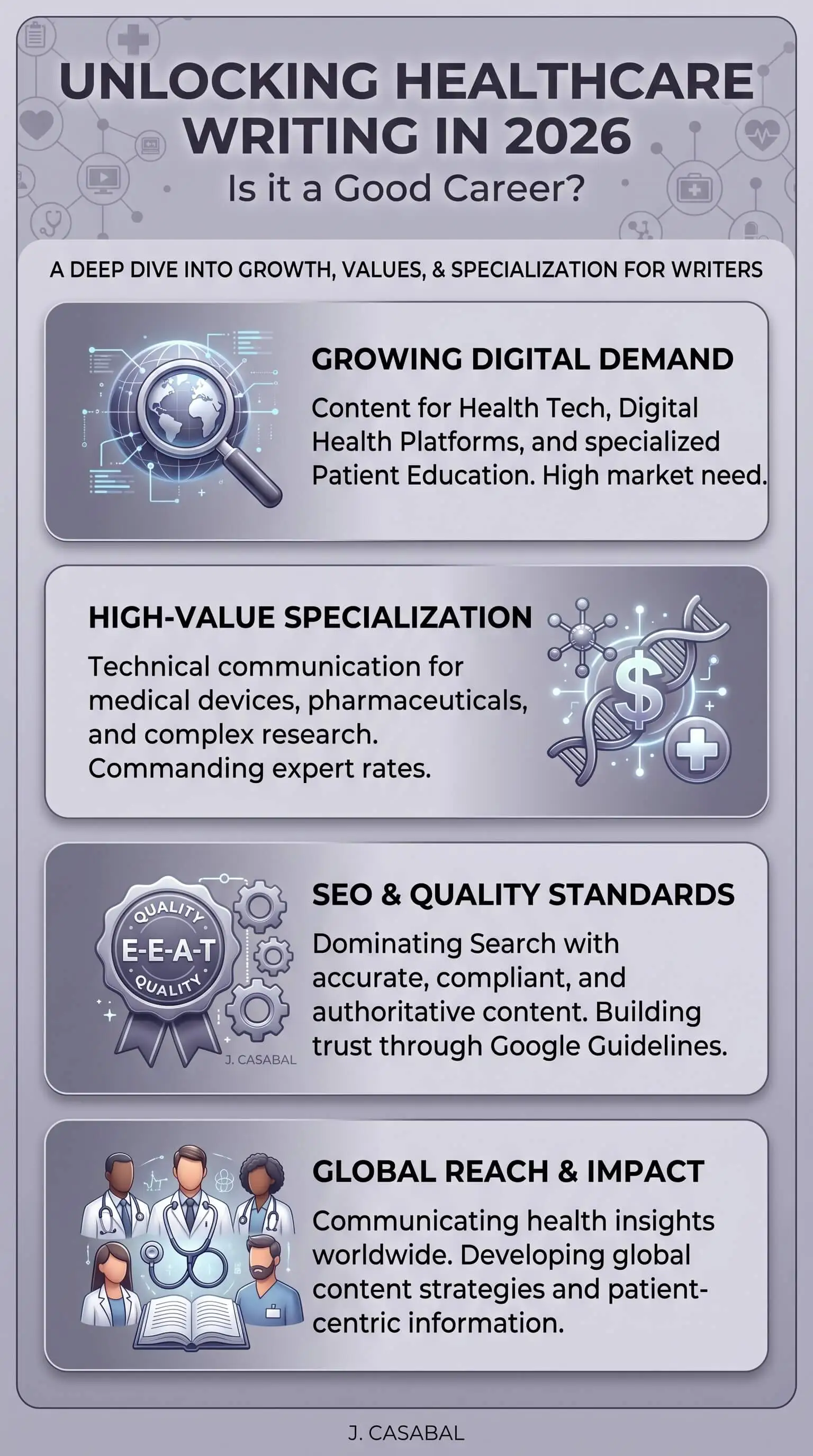
Healthcare content writing is a viable, well-paid niche in 2026, with steady work from hospitals, health brands, and digital health companies.
It is the marketing and education side of health writing, separate from clinical or regulatory medical writing, and it does not require a medical degree.
The skills that matter are clear writing, honest research, working SEO knowledge, and a refusal to guess on facts.
Pay runs from modest entry rates to strong specialist fees, though the income is uneven and you find your own clients.
AI has raised the value of writers who can check facts and add real expertise.
If you want to see how a specialist packages this work as a service, this example is worth studying: freelance healthcare content writer It shows how focused medical SEO content gets positioned and sold, which helps whether you plan to write it yourself or hire someone who does.
What a Freelance Healthcare Content Writer Actually Does
A freelance healthcare content writer takes medical and wellness information and makes it clear enough for an ordinary person to act on. In practice that means blog posts, patient education pages, condition and treatment explainers, website copy, and email newsletters for hospitals, clinics, health brands, and the newer wave of digital health companies.
This is the marketing and education side of health writing. It isn’t clinical or regulatory medical writing, which handles trial reports and regulator submissions and usually wants a science degree behind it. Content writing asks for a different mix: plain-language skill, the patience to research properly, and the judgment to know when a sentence needs a better source than the first one you found. The writers I’ve watched do well treat accuracy as part of the craft. The ones who struggle treat it as a step they can rush.
Why Demand Keeps Rising in 2026
Demand keeps climbing for a handful of connected reasons, and none of them look likely to reverse. People research symptoms and treatments online long before they call a doctor, so every hospital, insurer, and health brand wants to be the trustworthy result they find. Search and AI answer tools have raised the bar too. They reward content that shows real expertise and real sourcing, which means thin, generic filler no longer ranks the way it once did. Add an aging population and the steady spread of telehealth, and there are simply more conditions, services, and products that need a clear explanation.
AI belongs in this story, though not as the threat some writers expect. Generating a draft about diabetes or wound care takes seconds now. Standing behind that draft does not. Health content carries real consequences when it gets something wrong, so the value has moved toward writers who can check facts, add what they actually know, and put their name on the result. The work is shifting toward judgment, not away from it.
What You’ll Earn and What It Takes
Pay covers a wide range, and anyone who quotes you one number is guessing. Newer writers often land near 10 to 25 cents a word, or a few hundred dollars for an article. Writers with a track record charge more, through higher project fees, monthly retainers, and hourly rates well above general content work. Healthcare sits at a premium over ordinary blogging because the subject is harder and the cost of getting it wrong is higher.
You will not need a medical degree for this. You will need to write clearly, research from sources you can defend, understand SEO well enough to be useful, and stay comfortable interviewing an expert who knows far more than you do, especially when creating medical healthcare copywriting services for clinics, health brands, and healthcare companies. A clinical background helps. So does journalism or marketing experience. The honest catch is that freelance income is uneven. Work arrives in waves, and finding the next client is part of the job rather than a distraction from it.

“My healthcare clients stopped paying me for words a while ago. They pay me for judgment. Anyone can generate a passable draft about diabetes or wound care in seconds. What stays hard to find is a writer who can tell which sentence needs a citation, spot the claim a doctor will object to, and word an explanation so a frightened patient actually understands it. I built my rates on that gap, and in 2026 it is wider than I have ever seen it. Pick a focus, get the facts right every time, and you will not run short of work.”
7 Essential Resources
These are the places I point new healthcare writers toward. Each one earns its spot for the skills, standards, or community it gives you.
American Medical Writers Association (AMWA). The main professional body for medical communicators. Worth joining for the training, the Medical Writer Certified credential, the annual conference, and a directory that clients actually search.
Association of Health Care Journalists (AHCJ). Built for the journalism side of health writing, with training, conferences, and a freelance network that trades real leads.
Health Writer Hub. Training made specifically for health and medical writers, including courses that assume you are starting from zero.
Editorial Freelancers Association (EFA). The business side of freelancing, with rate guidance, courses, a job list, and a member directory.
American Society of Journalists and Authors (ASJA). A long-running organization for nonfiction freelancers. Useful for client connections, education, and backup when a contract goes sideways.
AMA Manual of Style. The style reference most medical and health publishers expect you to know. Learning it early makes you look like a professional before you feel like one.
Content Marketing Institute. Solid grounding in content marketing itself, plus career advice and salary research that maps straight onto this work.
Supporting Statistics
Writing pays a steady, real wage. The U.S. Bureau of Labor Statistics puts the median annual wage for writers and authors at $72,270 as of May 2024, with employment growing 4 percent through 2034 and about 13,400 openings a year. Not a windfall. A living.
The wider medical writing field is growing fast. Grand View Research expects the global medical writing market to reach roughly $8.38 billion by 2030, growing 10.5 percent a year from 2024. That figure covers clinical and regulatory work alongside communications, so read it as a sign of direction rather than a freelance rate card.
Businesses hand their content to outside writers. Siege Media found in its 2026 research that 86 percent of content marketers outsource at least part of their content work. That outsourced share is the opening a freelance writer steps into.
Final Thoughts
So, my honest opinion. Healthcare content writing is a good career in 2026, and a steadier one than most writing niches, but it suits a particular kind of person. If you find medicine genuinely interesting and you don’t mind reading a study to get one sentence right, you will do well here. If research feels like a chore to rush past, this niche will wear you down, and fast.
For the right person, the timing is good. The work is there, the rates are healthy, and AI has made careful human judgment more valuable rather than less. Start small. Pick one area of health you care about, write a couple of strong samples, and treat your first few clients as the start of a reputation instead of a quick paycheck. That is how a side income turns into the thing you do.
Frequently Asked Questions
Is healthcare content writing in demand in 2026?
Yes. Hospitals, insurers, health brands, and digital health companies all need accurate content, and search and AI tools now favor writing that shows real expertise. For writers who can meet that bar, the work is steady.
Do I need a medical degree to become a healthcare content writer?
No. This side of the field rewards clear writing and careful research over clinical credentials. A medical or nursing background helps you earn trust faster, but plenty of strong healthcare writers come from journalism, marketing, or general content work.
How much do beginner healthcare content writers earn?
Most beginners start near 10 to 25 cents a word, or a few hundred dollars an article. Rates climb once you have a focus, a portfolio, and a record of getting facts right. Healthcare generally pays better than generic blogging.
How do I get my first healthcare writing client?
Pick a niche, write two or three strong samples even if you assign them to yourself, and pitch small health publications, agencies, and brands. Job boards and professional groups help. Early referrals help more.
What’s the difference between healthcare content writing and medical writing?
Healthcare content writing produces marketing and education material for general readers: blogs, patient pages, web copy. Medical writing usually means clinical, regulatory, or scientific documents for experts and regulators, and it normally expects a science degree.
Ready to Start Your Healthcare Writing Career?
You don’t need anyone’s permission to start. Pick one health topic you actually find interesting, write a single strong sample this week, and put it somewhere a client can find it, even if that sample explores niche areas like board game copywriting services tied to healthcare education or wellness brands. Subscribe for more practical guides on building a writing career, and treat that first sample as the start of something real, not a throwaway.